
Planning a Fukuoka trip? Lock flights, hotels, and experiences at the best price.
✈️ Compare flights on Skyscanner🏨 Book hotels on Trip.com🎫 Book Fukuoka experiences on Klook
🍴 Check reviews and English menu on Tabelog
Introduction
Most Fukuoka one-day itineraries treat food and culture as two separate boxes — eat ramen here, see a temple there, never mind whether they connect. This plan is built differently: a spice-driven Indo-French lunch by Fukuoka’s most globally recognized chef pairing, a quiet hour inside an 800-year-old Buddhist temple right in the middle of Hakata, and an early dinner at the no-frills tempura institution that locals queue at every single day. Three stops, one rhythm, all reachable by subway and short walks.
I’ve worked in Japanese culinary education and traveled around the world before settling in Fukuoka, and this is the day I run when a foodie friend lands at FUK with only 24 hours. It tells you, in three meals and one temple visit, what makes this city different from Tokyo or Osaka.
The 1-Day Plan
Lunch: GohGan — Indo-French Fusion by Fukuyama Tsuyoshi × Gaggan Anand
GohGan is the first physical restaurant from the collaboration between Fukuyama Tsuyoshi — owner-chef of Michelin-starred La Maison de la Nature Goh here in Fukuoka and a multi-time Asia’s 50 Best honoree — and Gaggan Anand, the Indian chef whose Bangkok restaurant topped Asia’s 50 Best four times in a row. Note: GohGan itself is not a starred restaurant; it’s the more accessible, lunch-friendly playground where these two chefs experiment with Indian techniques on French and Japanese ingredients. The 010 Building location sits along the Naka River, with a 55-seat dining room facing an open kitchen and 20 terrace seats over the water.
The menu is à la carte — no obligatory tasting commitment at lunch — and reads like nowhere else in Fukuoka: Goma Saba Tostada (Hakata-style mackerel on a Mexican tostada), Pani Puri as the welcome bite, Spicy Crab Curry, Lamb Kebab, Bagna Cauda, HAKATA Goh-rimon (a pun on Hakata’s famous Tsuruya no manju reimagined as savory). If you want the full statement, the 7,000 yen Omakase Course is the cleanest way in. À la carte dishes start around 800–3,000 yen, so two people can eat well for ~5,000 yen each at lunch.
Why this opens your day: it grounds you immediately in what Fukuoka actually is in 2026 — a port city where Indian, French and Japanese kitchens overlap without anyone forcing the issue. After eating here, the temple you walk to next stops feeling like a tourist box-tick.
Reservation tip: book through TableCheck (linked from the official 010bld.com site). Walk-in lunch seats exist on weekdays but disappear by 12:30 on weekends. Closed Mondays — plan accordingly.
GohGan — The Details
- Address: 010 Building 1F, 1-4-17 Sumiyoshi, Hakata-ku, Fukuoka 812-0018
- Access: ~7 min walk from Nakasu-Kawabata Station (Subway Kuko Line) or Tenjin-minami Station (Nanakuma Line)
- Lunch: Tue–Sun 12:00–15:00 (food L.O. 14:00, drink L.O. 14:30)
- Dinner: Tue–Thu & Sun 17:00–22:00 / Fri–Sat 17:00–24:00
- Closed: Mondays (occasional event closures — check Instagram @gohganfuk)
- Reservations: TEL 092-281-0555 or TableCheck
Afternoon: Tocho-ji — An 800-Year-Old Buddhist Temple in Hakata
Tocho-ji is a Buddhist temple, not a Shinto shrine. The distinction matters: founded in 806 by Kobo Daishi (Kukai) on his return from China, it is the oldest Shingon-sect temple in Kyushu and the family temple of the Kuroda clan, who ruled Fukuoka domain in the Edo period. A 10-minute walk from GohGan brings you to a different historical layer of the same city.
The reason to come specifically here, rather than to a generic shrine, is the Fukuoka Daibutsu: a 10.8-meter-tall seated wooden Buddha completed in 1992 — the largest seated wooden Buddha statue in Japan. Behind the statue is a darkness corridor (jigoku-gokuraku-meguri) you walk through in pitch black; you reach a single point of light that represents salvation. Entry to the Daibutsu hall and darkness corridor requires a ¥50 offering for incense and a candle (not a ticket fee — it’s a small osaisen-style offering, in keeping with Japanese temple custom). The walk takes about three minutes, and is genuinely unsettling in the way that travel is supposed to be unsettling. Beyond the Daibutsu, the wooden five-story pagoda (built 2011 in classical proportions) and the Heian-period seated Senju Kannon statue (designated a National Important Cultural Property) are quietly worth the time.
Why this works at this point in the day: after a creative, plate-driven lunch you need volume — physical space, silence, time to digest. Tocho-ji gives you all three in 45–60 minutes, then sends you back into Hakata Station territory with the right pace for an early tempura dinner.
Practical note: precincts are open all day, but the Daibutsu hall and main treasures close at 16:45. Arrive by 16:00 at the latest. The grounds are free; a ¥50 offering (for incense and a candle) is requested to enter the Daibutsu hall and darkness corridor.
Tocho-ji — The Details
- Address: 2-4 Gokushomachi, Hakata-ku, Fukuoka 812-0037
- Access: Direct exit from Gion Station (Subway Kuko Line), 1-min walk; or 10 min walk from Hakata Station
- Hours: 9:00–16:45 daily (Daibutsu hall hours)
- Admission: Free for grounds; ¥50 offering (for incense and a candle) to enter the Daibutsu hall and darkness corridor
- Sect: Shingon (Buddhist temple, not a Shinto shrine)
Dinner: Tempura-dokoro Hirao Main Store — Fukuoka’s No-Frills Tempura Institution
I want to be honest about one thing: the Hirao main store sits near Fukuoka Airport, not downtown — about 25 minutes from Tocho-ji by subway (Kuko Line to Fukuoka Airport Station / Fukuokakuko Station) plus a 15–20 minute walk. Alternatively, take the Nishitetsu Bus from Hakata Station, which drops you closer to the shop. So this becomes either an early dinner before flying out the next morning, or a deliberate detour to eat where Fukuoka locals actually queue. The line forms before 11:00 and again from 17:00; you write your name on the clipboard at the door and they call you in waves.
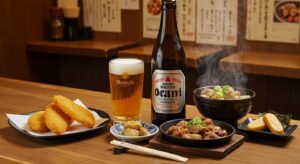
Once you sit at the counter, the system reveals itself: order a teishoku set (around 800–1,200 yen — yes, that price is correct), and the kitchen fries each piece of tempura to order, sliding it onto your plate one item at a time. Shrimp, white-fish, kisu, eggplant, lotus root, kakiage. The batter is thin, almost transparent; the oil is fresh and unsweet; nothing tastes heavy. Their signature Ika no Shiokara (yuzu-flavored salted/fermented squid — a Japanese delicacy, not just plain salted squid), pickled high-na (takana-zuke), and grated daikon are set on each table for free refills — locals routinely build a second meal out of the side dishes alone. This is the most Fukuoka thing in this whole itinerary.
Why this closes the day correctly: after refined French-Indian fusion and an 800-year-old temple, the third move should be honest, fast, and cheap. Hirao is all three. You walk out for under 1,500 yen with the most satisfying tempura you’ll eat anywhere in Japan at that price, and if you have an early flight from FUK the next morning, the airport is already 5 minutes away.
Reservation tip: no reservations accepted — it’s queue-based only. Last order is around 19:30 (closes 20:00 sharp), so plan to arrive by 18:30. They run multiple branches across Fukuoka; the main store (near Fukuoka Airport) is the original and has the longest queue but most consistent kitchen.
Tempura-dokoro Hirao Main Store — The Details
- Address: 2-4-1 Higashi-hirao, Hakata-ku, Fukuoka 812-0853
- Access: ~15–20 min walk from Fukuoka Airport Station (Fukuokakuko Station, Subway Kuko Line); or Nishitetsu Bus from Hakata Station; ~5 min by taxi from Fukuoka Airport
- Hours: 10:30–20:00 daily (last order ~19:30)
- Reservations: Not accepted — walk-in / clipboard queue only
- Budget: Teishoku sets ¥800–¥1,200; free refills of Ika no Shiokara (yuzu-flavored salted/fermented squid), takana-zuke, and daikon-oroshi at every table
- Note: Officially “Tempura-dokoro Hirao” (天麩羅処ひらお) — a local Fukuoka chain, not the Tokyo Hirao
Route Summary
The day flows: 12:00 lunch at GohGan (Sumiyoshi, Naka River side) → 14:30 walk 10 min north to Hakata’s old town → 15:00–16:30 Tocho-ji → 16:30 subway from Gion Station on the Kuko Line → 17:00 Fukuoka Airport Station (Fukuokakuko), 15–20 min walk → 17:25 join Hirao queue → 18:00 dinner. Total walking: about 30 minutes; total subway: about 12 minutes; total spend: roughly ¥7,500 per person before drinks.
- The Fukuoka City Subway 1-day pass (¥640) covers the entire route and pays for itself if you also commute to/from your hotel.
- For the GohGan → Tocho-ji leg, walking is genuinely faster than transferring trains — the route runs along Naka River and Kushida Shrine area, which is its own free sightseeing.
- Activate a Japan eSIM before landing — TableCheck (GohGan booking) and Tabelog English are easier when you can authenticate from the gate.
- If your itinerary continues to Yufuin, Beppu, or Nagasaki, the JR Kyushu Rail Pass usually pays for itself on a single round trip.
Planning a Fukuoka trip? Lock flights, hotels, and experiences at the best price.
✈️ Compare flights on Skyscanner🏨 Book hotels on Trip.com🎫 Book Fukuoka experiences on Klook🍴 Check reviews and English menu on Tabelog
Where to stay near this route
Pick the district that matches your pace — Hakata for the shinkansen, Tenjin for shopping and nightlife, Nakasu-Kawabata for river views (closest to GohGan and Tocho-ji), and Fukuoka Airport for early departures (closest to Hirao).
Conclusion
Most one-day plans for Fukuoka feel like a checklist. This one is built around three things that are genuinely different here: a chef collaboration that doesn’t exist anywhere else in Japan (Fukuyama × Gaggan), a Buddhist temple holding the country’s largest seated wooden Buddha, and a tempura counter where locals queue for ¥1,000 sets next to grandmothers refilling their free Ika no Shiokara. Eat the fusion, walk the temple, queue for the tempura. That’s the day.
Practical FAQ for your Fukuoka food day
Do I need an eSIM before I arrive?
Yes — Google Maps, Tabelog and TableCheck (GohGan’s reservation system) all assume you have data the moment you land. Activating a Japan eSIM before boarding saves you from the airport SIM counters and lets you navigate from the arrival gate straight to lunch.
Should I buy the JR Kyushu Rail Pass?
For a single day inside Fukuoka City, no — the ¥640 Subway 1-day pass is enough. But if you extend to Yufuin, Beppu, Kumamoto or Nagasaki, the JR Kyushu Rail Pass usually pays for itself on one round trip. Buy online before flying and exchange the voucher at Hakata Station’s JR ticket office.
Buy the JR Kyushu Rail Pass on Klook
Do I need to reserve GohGan?
For weekday lunch you can usually walk in before 12:30. Weekend lunch and any dinner — reserve via TableCheck from the official site (010bld.com) or call 092-281-0555. They are closed Mondays.
Will English menus be available?
GohGan has English staff and an English à la carte menu. Tocho-ji has English signage at major points. Tempura-dokoro Hirao has a picture-based teishoku menu and a Japanese-only ticket vending system at the entrance — staff are used to walking foreign customers through it. None of these stops requires Japanese language ability.
Is Tocho-ji a shrine?
No — it is a Buddhist temple of the Shingon sect, founded in 806 AD. Shrines (jinja) are Shinto; temples (tera / -ji) are Buddhist. Tocho-ji’s defining feature is the Fukuoka Daibutsu, the largest seated wooden Buddha statue in Japan.
Planning a Fukuoka trip? Lock flights, hotels, and experiences at the best price.
✈️ Compare flights on Skyscanner🏨 Book hotels on Trip.com🎫 Book Fukuoka experiences on Klook🍴 Check reviews and English menu on Tabelog


Comments