
Planning a Fukuoka trip? Lock flights, hotels, and the JR Kyushu Rail Pass at the best price.
✈️ Compare flights on Skyscanner🏨 Book hotels on Trip.com🎫 Book the JR Kyushu Rail Pass & experiences on Klook
🍴 Check reviews and English menu on Tabelog
Introduction
The Kanmon Strait is the 700-meter sliver of sea that separates the main island of Honshu from Kyushu. At its narrowest point you can read the streetlamps on the opposite shore with the naked eye — and yet the moment you cross it, the dialect, the food rituals, and the architectural texture quietly change. Shimonoseki sits on the Honshu side; Mojiko, in Kitakyushu’s Moji Ward, on the Kyushu side. Both ports boomed simultaneously through the Meiji and Taisho eras as international trade hubs, and both have left intact red-brick warehouses, neo-Renaissance station buildings, and three-story wooden ryotei standing where they were a century ago. From Fukuoka, the bullet train reaches Kokura in 15 minutes, which makes this one of the densest day trips in Kyushu: the original yaki-curry, an Important Cultural Property ryotei, the birthplace of legal fugu cuisine, and Kokura’s signature iron-pot gyoza, all in eight hours.
This article lays out a Hakata-departing day plan combining Shinkansen, JR local lines, and the Kanmon ferry. As a writer who completed a round-the-world journey before settling in Fukuoka, I am sending you to the four spots that survive a global comparison. Lunch is the 90-year-old yaki-curry that originated on the Mojiko waterfront. The afternoon is a free walk-through of the wooden ryotei where the man fictionalized in The Pirate’s Daughter drank with shipping magnates. After that, you cross the strait by ferry and have a fugu kaiseki at the place where Japan officially legalized eating it. The day ends back in Kokura with iron-pot gyoza and cold beer.
Planning a Fukuoka trip? Lock flights, hotels, and the JR Kyushu Rail Pass at the best price.
✈️ Compare flights on Skyscanner🏨 Book hotels on Trip.com🎫 Book the JR Kyushu Rail Pass & experiences on Klook🍴 Check reviews and English menu on Tabelog
The Kanmon 1-Day Plan
Lunch: Curry Honpo Mojiko Retro — The 90-Year-Old Original of Mojiko’s Famous Yaki-Curry
Two minutes’ walk from JR Mojiko Station, on the ground floor of the Awaya Building facing the harbor, you slide open an old wooden door and the first thing that hits you is browned cheese — and underneath that, the architecture of the spice. Curry Honpo Mojiko Retro is one of the leading specialists of yaki-curry, the oven-baked curry-rice that, by local consensus, was invented by accident at a Mojiko coffee shop before World War II. Rice gets topped with curry, an egg, and cheese, then finished in a hot oven until the surface is one moment short of browning. Within those constraints every shop has its own philosophy — whether to lay down a béchamel base, how runny to keep the egg, when exactly to pull the dish from the oven.
The signature here is the Three-Meat Yaki-Curry: beef, pork, and chicken generously layered over the rice and finished in a custom oven until the cheese surface is one moment short of browning. The spice blend is restrained — there is a Japanese dashi tail at the back of the palate that you would never find in an Indian or Thai curry — and after years of comparing curries on three continents, I would call this the asymptote of the “curry adapted by Japan, for Japanese tastes.” Mains run ¥1,200–¥1,800, English menu available, spice level adjustable.
From order to arrival, plan on about 12 minutes. Open with the small salad or pickles while you wait, and finish your water before the iron plate arrives — the cheese is literally still bubbling when it lands on the table, so the first sixty seconds belong to your mouth, not your camera.
Practical context: the Mojiko Retro pedestrian zone is compact. JR Mojiko Station, the Sankiro ryotei, and the Sakaemachi Pier ferry terminal all sit within a 500-meter radius — leave the car at the rental office and stay on foot.
Curry Honpo Mojiko Retro — The Details
- Address: 1F Awaya Building, 9-2 Minato-machi, Moji-ku, Kitakyushu, Fukuoka 801-0852
- Access: 2 min walk from JR Kagoshima Main Line “Mojiko Station”; opposite the Kaikyo Plaza waterfront
- Hours: 11:00–20:00 daily (last order 19:30)
- Phone: +81-93-331-8839
- Website: curry-honpo.com
- Visit tip: Saturdays and Sundays 12:00–13:30 carry a 20–30 minute wait. Aim for 11:00 sharp or after 14:00
Walk: Sankiro — The Wooden Ryotei Where the Real “Pirate’s Daughter” Drank, Now an Important Cultural Property
Drink your post-lunch coffee on a harbor bench, then walk five minutes uphill. The street noise drops one notch and a three-story wooden ryotei suddenly appears — this is Sankiro. Built in 1931 (Showa 6), it is one of the largest surviving wooden ryotei buildings in Kyushu, now registered as a National Tangible Cultural Property and managed by the City of Kitakyushu. Sazo Idemitsu, founder of Idemitsu Kosan and the historical figure on whom Naoki Hyakuta’s bestselling novel The Man Called Pirate is based, was a regular here, and the great hall where he and other shipping-and-finance magnates drank survives intact. The first and second floors are free to enter. The third-floor hyakujojima (“hundred-mat hall,” in fact 88 mats), the polished staircase, and the openwork transoms are first-class craftsmanship that the modern construction economy could no longer reproduce.
Adjacent to the main building is Sankiro Saryo, a working restaurant that serves a kaiseki lunch and a sea-bream chazuke set built around the original ryotei menu. Within this plan, however, lunch is already accounted for at Curry Honpo, so visit the main building only and continue down to the harbor.
Allow 30–40 minutes. The slope up to the building is stone-paved and slick in rain — wear a sneaker you can take on and off easily, because Sankiro is shoes-off and you switch into slippers at the entrance. English-language leaflets are stocked at the front desk, with a QR code that plays a short documentary on the building’s history.
Sankiro — The Details
- Address: 3-6-8 Kiyotaki, Moji-ku, Kitakyushu, Fukuoka 801-0833
- Access: 7 min walk from JR Mojiko Station (slight uphill); 6 min walk from Curry Honpo
- Hours: 10:00–17:00 (last entry 16:30); closed Mondays (next day if Monday is a holiday)
- Admission: Free
- Phone: +81-93-321-2653
- Website: mojiko.info/3kanko/sankiro
- Visit tip: Shoes-off entry — slip-ons help with the staircase. The third-floor 88-mat hall opens on a fixed schedule; ask at the front desk on entry
Fugu Pilgrimage: Shunpanro Honten in Shimonoseki — Where Japan Legalized Eating Fugu, Continuously Since 1888
Walk down from Sankiro to the harbor and board the Kanmon ferry at Sakaemachi Pier. Five minutes and ¥400 later, you are on the Honshu side at Karato Pier in Shimonoseki. From there, walk past Akama Shrine and up the small hill that overlooks the strait — about ten minutes — and you are standing in front of Shunpanro Honten. This is the place where eating fugu was officially legalized in Japan: in 1888 (Meiji 21), Prime Minister Hirobumi Ito was caught at this inn during bad weather with no other fish on the menu, ate fugu, and was so impressed that he designated it Fugu License No. 1 the following year. It is the historical pivot point of an entire genre of Japanese cuisine. A lunch overlooking the strait that Hirobumi Ito himself loved is worth every minute of the three-day-ahead reservation it requires.
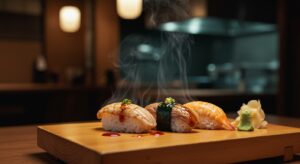
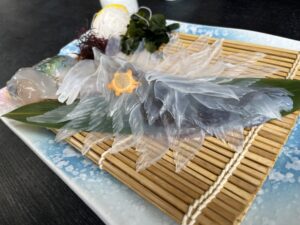
The signature is the fugu kaiseki. It opens with fuku-sashi (fugu sliced so thin the plate’s chrysanthemum pattern shows through), continues into fuku-chiri (the hot pot), shirako-yaki (the milt, in season January–March), karaage, hire-zake (toasted-fin sake), and closes with zosui (rice porridge in the residual broth). I have eaten fish on six continents and I can tell you that fugu’s combination of clean bite and zero oiliness has no real analog. Lunch kaiseki starts around ¥8,500; full dinner courses run ¥15,000–¥30,000. The dining hall and private rooms overlook the strait, in keeping with the inn’s role as host to prime ministers and emperors.
For this plan, with timing and budget in mind, I recommend the lunch kaiseki or the fuku-zukushi bento (lunch only, around ¥6,000). Lunch service runs 11:00–14:00 (last order 13:30). Reservations are required; book at least 3 days in advance via the official site or by phone.
Walking note: the Karato Pier-to-Shunpanro stretch is the so-called Kanmon Walk, a path that hugs the strait with a clear view of Mojiko’s red-brick warehouses on the opposite bank. Akama Shrine — dedicated to the child-emperor Antoku, who drowned in the 1185 Battle of Dan-no-ura right offshore from here — sits on the same path. Five extra minutes there ties the entire history of the strait together.
Shunpanro Honten — The Details
- Address: 4-2 Amidaji-cho, Shimonoseki, Yamaguchi 750-0003
- Access: 10 min walk from Karato Pier (Kanmon ferry); 10 min by taxi from JR Shimonoseki Station
- Hours: Lunch 11:00–14:00; Dinner 17:00–22:00 (open year-round)
- Phone: +81-83-223-7181
- Website: shunpanro.com
- Budget: Lunch kaiseki ¥6,000–¥10,000 / Dinner kaiseki ¥15,000–¥30,000
- Visit tip: Reserve at least 3 days ahead. To request a strait-view window seat, ask for “ちょうぼう席 (chōbō-seki)” when booking. Wild tora-fugu peaks October–March, but the inn serves it year-round using farm-raised stock
Dinner: Kokura Tetsunabe Sohonten — Closing the Day with Kokura’s Iron-Pot Gyoza
After lunch in Shimonoseki, take the Kanmon ferry back to Mojiko, transfer to the JR Kagoshima Main Line, and 13 minutes later you are at Kokura Station. Walk seven minutes south into the Uomachi side streets and you’ll spot the lantern. Kokura Tetsunabe Sohonten is the headquarters of Kokura’s other soul food — tetsunabe gyoza, the iron-pot dumplings that are an entirely separate lineage from the better-known Hakata gyoza. After a fugu kaiseki, switching gears to a draft beer here is exactly the right release.
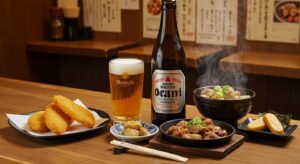
Tetsunabe gyoza are small, pleated dumplings seared in a heavy cast-iron pan and served at the table inside that same pan. The residual heat keeps the last dumpling as hot as the first, and the seared crust stays crisp until it hits your mouth. The skin is thin, the filling leans vegetable rather than heavy on pork, and the whole thing pairs with beer or highball with a lightness that makes it dangerously easy to keep ordering. A single pan is eight pieces for around ¥600 — the local move is to order pan number two before you finish pan number one.
The room is a mix of counter and small tatami booths, and the crowd splits roughly half-and-half between local salarymen and visiting tourists. English menu is available, but pointing works fine. Credit cards accepted, online reservation possible via Hot Pepper. The room fills with regulars after 20:00, so 18:30–19:00 arrival is the sweet spot.
Flavor note: tetsunabe gyoza are complete as served, but a tiny dab of the yuzu-kosho (yuzu-chili paste) on the table — placed on the skin, not the filling — adds an extra layer of brightness. The yuzu-kosho habit is shared across Kyushu’s gyoza culture, including Hakata; pair it with the soy-vinegar dip and find your own ratio.
Kokura Tetsunabe Sohonten — The Details
- Address: 2-3-12 Uomachi, Kokurakita-ku, Kitakyushu, Fukuoka 802-0006
- Access: 7 min walk from JR Kagoshima Main Line / Shinkansen “Kokura Station”
- Hours: Daily 11:00–23:00, continuous service (lunch menu served until 15:00)
- Phone: +81-93-513-8033
- Website: tetsunabe-g.com
- Budget: ¥1,500–¥2,500 per person (two pans of gyoza + two beers)
- Visit tip: Eat from the front row of the pan toward the back to keep the crust crisp until the last piece. Eight pieces per pan is rarely enough — order two pans up front
Route Summary (Times & Travel)
The day at a glance: 09:00 Hakata Station, board the Sakura/Mizuho Shinkansen for Kokura (15 min, separately ticketed at ~¥2,160 one-way) → 09:30 Transfer at Kokura to the JR Kagoshima Main Line for Mojiko (13 min) → 09:50 Arrive Mojiko Station → 11:00 Lunch at Curry Honpo Mojiko Retro → 12:30 Walk-through at Sankiro (7-min uphill stroll) → 13:30 Sakaemachi Pier, board the Kanmon ferry to Karato (5 min, ¥400) → 14:00 Late lunch kaiseki at Shunpanro Honten (reservation required) → 16:00 Karato Pier ferry back to Mojiko, JR back to Kokura (13 min) → 17:00 Light walk in Kokura, hotel check-in → 18:30 Dinner at Kokura Tetsunabe Sohonten → 20:30 Shinkansen back to Hakata Station (15 min). Total transit: about 60 min. Total walking: roughly 3 km. Total budget: ¥18,000–¥25,000 per person, anchored by the Shunpanro lunch kaiseki.
Important rail-pass notice: the Hakata–Kokura Shinkansen segment is operated by JR West, so the JR Kyushu Rail Pass cannot be used on this Shinkansen. To keep the 15-minute leg, buy a separate Shinkansen ticket (~¥2,160 one-way). If you are using the JR Kyushu Rail Pass, take the Limited Express Sonic instead (about 45 min between Hakata and Kokura, 2–3 trains per hour). The JR Kagoshima Main Line between Mojiko and Kokura, and the Sonic between Hakata and Kokura, are both covered by the pass.
Trip Prep: JR Kyushu Rail Pass, eSIM & Fugu Reservation
This itinerary uses Shinkansen, JR local trains, and the Kanmon ferry. Note: the Hakata–Kokura Shinkansen is JR West, so it is not covered by the JR Kyushu Rail Pass. Choose between (a) buying a separate Shinkansen ticket (~¥2,160 one-way) for a 15-minute leg, or (b) using the JR Kyushu Rail Pass on the Limited Express Sonic (about 45 minutes). The wider JR Sanyo-San’in-Northern Kyushu Pass covers the Sanyo Shinkansen and pairs naturally if you are coming from Kansai or Hiroshima. An eSIM purchased on Klook keeps Google Maps and your reservation calls to Shunpanro as snappy as on a domestic SIM. Shunpanro requires reservation at least 3 days in advance — a lunch overlooking the strait that Hirobumi Ito himself loved is worth every minute of the booking effort.
FAQ
Q: What is the fastest way between Hakata and Kokura, and is the JR Kyushu Rail Pass valid?
A: The fastest option is the Sanyo Shinkansen (Sakura/Mizuho, 15 minutes), but it is operated by JR West and is not valid with the JR Kyushu Rail Pass — you have to buy a separate ticket (~¥2,160 one-way). If you want to use the JR Kyushu Rail Pass, take the Limited Express Sonic (about 45 minutes, 2–3 trains per hour), which is fully covered. If you are continuing into Kyushu from Kansai or Hiroshima, the JR Sanyo-San’in-Northern Kyushu Pass covers the Sanyo Shinkansen as well and is the more efficient buy.
Q: How often does the Kanmon ferry run?
A: The Mojiko–Karato ferry runs about 20 times a day, every 20 minutes (every 15 minutes in morning and evening peaks). Crossing time is 5 minutes; ¥400 adult / ¥200 child. No advance booking — buy your ticket at the pier. Service can suspend in rough weather; check the Kanmon Kisen site the morning of your trip.
Q: What is the fugu season and price range?
A: Wild tora-fugu peaks October–March, with the prized milt available December–February. Shunpanro also serves year-round courses using farmed tora-fugu, so even outside peak you still have the experience of eating fugu where Japan first legalized it. Lunch kaiseki ¥6,000–¥10,000; full dinner courses ¥15,000–¥30,000.
Q: Isn’t this too packed for a single day?
A: Because all transitions are by Shinkansen, JR local, and ferry, with very short walking segments, the day has more breathing room than it looks on paper. The Shunpanro lunch kaiseki blocks out a 2-hour window, so anchor everything around a 14:00 reservation and a 16:00 departure. Skipping Sankiro creates an awkward gap, so keep that walk-through in.
Q: Is yaki-curry spicy?
A: The standard at Curry Honpo is on the mild side — closer to a European-style curry than to an Indian one — and travelers who normally avoid spicy food have no problem with it. Spice level can be adjusted on order.
Closing Notes
The Kanmon Strait is one of the most efficient day trips in Kyushu: the Meiji-era port, the inn where Japan first legalized fugu, and Kokura’s iron-pot gyoza, all reachable from Hakata by morning Shinkansen and back by night. The browned cheese on the iron plate at Curry Honpo, the 90-year creak of Sankiro’s staircase, the chrysanthemum-thin slice of fugu lifted off Shunpanro’s plate, and the seared crust of a Kokura iron-pot dumpling holding its temperature on the table — none of these belong in the same category as the more famous tourist circuits in Tokyo or Kyoto. They are a quieter kind of authenticity, traveled by Shinkansen and ferry rather than tour bus. Book the fugu three days out, and the rest of the day will rearrange itself in your favor.
Planning a Fukuoka trip? Lock flights, hotels, and the JR Kyushu Rail Pass at the best price.
✈️ Compare flights on Skyscanner🏨 Book hotels on Trip.com🎫 Book the JR Kyushu Rail Pass & experiences on Klook🍴 Check reviews and English menu on Tabelog

Comments